



Frequently Asked Questions
Ans: Laser cleaning offers clear advantages over traditional sandblasting for precision applications. Unlike sandblasting, which requires continuous grit replacement and abrades the base material, laser cleaning uses only electricity as a consumable and leaves the base material unharmed when parameters are set correctly. It provides high selectivity by cleaning only the programmed area, generates minimal waste in the form of easily captured fume, and integrates easily with CNC, robotic, or in-line automation. Operator safety is also improved through laser-safe enclosures or eyewear combined with fume extraction, avoiding the silica dust and full PPE demands of sandblasting. While sandblasting can still be faster for very large, rough steel surfaces where base-metal damage is acceptable, laser cleaning delivers superior quality, lower running costs, and better process control for precision parts, moulds, and production lines.
Ans: Markolaser laser cleaning machines deliver precise, non-contact surface cleaning without damaging the base material. Key advantages include easy automation with CNC or robotic integration, improved operator safety through enclosed systems and fume extraction, and significantly lower long-term running costs. Markolaser systems are especially suited for precision parts, moulds, production lines, and applications where surface integrity and process consistency are critical. Book a laser cleaning trial.
Ans: Steel, stainless steel, aluminium, copper, cast iron, titanium, stone, concrete, glass and many plastics and composites. Results depend on the contaminant and substrate, so we test on your sample first.
Ans: Laser cleaning has no ongoing consumable cost, while dry ice must be bought and stored continuously. Laser is also more Sampling form selective and easier to integrate in-line; dry ice can suit large, irregular equipment cleaned occasionally.
Ans: Choose pulsed for precision work, moulds, thin or heat-sensitive parts and pre-weld cleaning. Choose CW for heavy rust on large steel structures where some heat and surface darkening are acceptable.
Ans: It depends on rust thickness, area per hour and laser type. A 100–300 W pulsed system is usually enough for light rust, moulds and precision parts; heavy rust on large areas often needs a higher-power system. A sample trial gives you a measured cleaning rate.
Ans: Prices depend on laser type, power and automation level. Contact us for a quotation based on your parts.
Ans: It removes oxides, oils and residue that cause weak or inconsistent welds. A clean, uniform surface improves weld strength and conductivity and reduces rejects.
Ans: Yes, with the right controls. Enclosed Class 1 workstations need no special eyewear; open handheld or robotic systems need laser-safety glasses, a controlled area and fume extraction. See our laser safety guide.
Ans: Yes. The cleaning head can be mounted on a robot, gantry or conveyor line and controlled by your PLC. Markolaser builds complete automated systems, including part handling and vision alignment.
Ans: Yes. Send us your sample and we'll clean it in our applications lab and share the results. Sampling form
Ans: Automotive, EV battery, mould and die, aerospace, electronics and heavy fabrication are the biggest users of laser cleaning. Automotive and EV makers use it to clean parts and battery tabs before welding or painting. Tyre and injection-mould shops use it to remove residue without taking moulds offline. Aerospace and electronics need it to strip coatings and oxides without damaging the base material, and fabricators use it for rust and weld-seam cleaning. It is also used in shipbuilding, railways and heritage restoration. Ready to Upgrade Your Cleaning Process?
Ans: Laser cleaning can remove rust, mill scale, oxides, paint, powder coatings, oil, grease, release agents, carbon deposits and weld discoloration. It can also prepare surfaces before welding, bonding or coating by removing thin contaminant films.
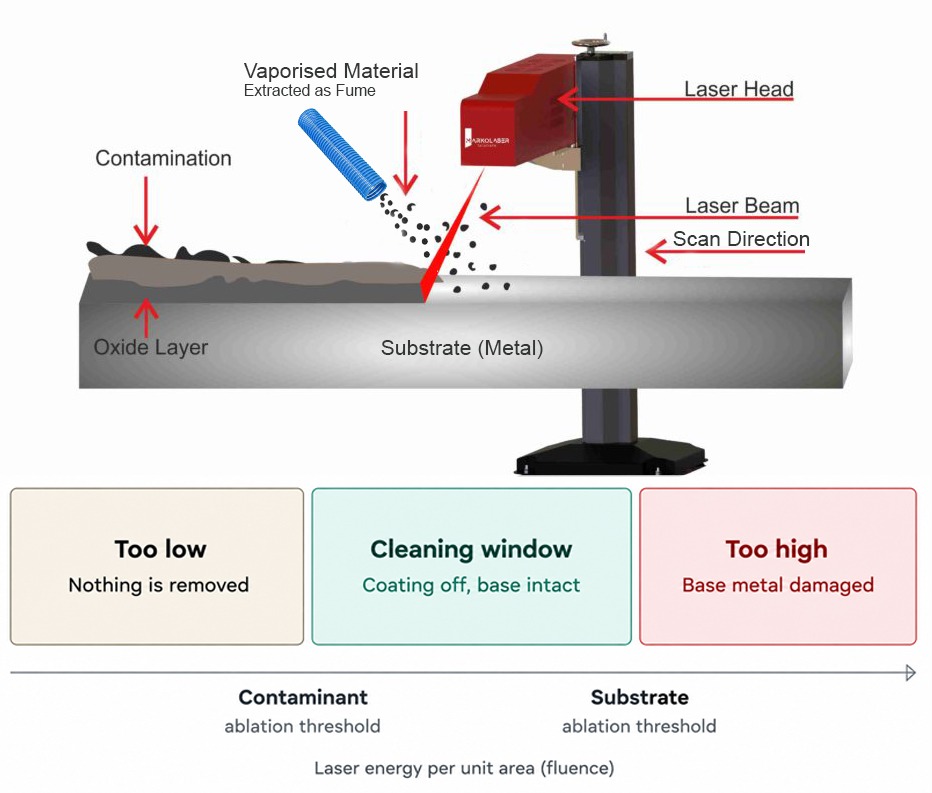
Ans: No, when the laser is set up correctly. Contaminants usually need much less laser energy to be removed than the metal underneath. The laser is tuned to work between these two levels, so the coating or rust is removed while the base metal stays below its own removal threshold.
Ans: Pulsed fiber lasers are the most common choice because their short, high-energy pulses remove contaminants with minimal heat reaching the base material. Continuous-wave fiber lasers are sometimes used for heavy rust or large areas where speed matters more than surface finish.